The Challenger Electrical Panel Problem in Bella Vista Homes (And How to Know If You Have One)
If you own an older home in Bella Vista, there is a real chance your electrical panel is one that most electricians would tell you to replace. It is called a Challenger panel, and it was installed in a large share of the homes built here during the 1980s and 1990s.
Epic Electric sees these panels constantly. Shannon Hadley, the owner and a licensed electrician with nearly three decades in the trade, estimates that the majority of older Bella Vista homes that have never been updated still have a Challenger panel sitting in the garage or on an exterior wall. “They were real cheap when contractors were building houses in the 80s and 90s,” Shannon says. “Real thin aluminum. And now they’re turning brown and purple, they’re overheating.”
Here is why it matters, and how to tell if you have one.
What a Challenger panel is, and why it is a problem
Challenger electrical panels were installed in hundreds of thousands of homes across the country during the 1980s and early 1990s. They were inexpensive, which is part of why builders used them so widely during that construction boom. The problem is in how they age.
The breakers and the connections inside Challenger panels have a documented tendency to overheat. Over years of normal use, the points where the breakers meet the bus bar develop resistance, and resistance generates heat. That heat cycle, warming up under load and cooling down again, repeats thousands of times over the life of the panel. The result is scorching, melting, and discoloration inside the panel that the homeowner never sees because the cover stays closed.
It is the same aging process Shannon sees in old breakers generally. “They heat up, they cool down, heat up and cool down, and then over time they get a little air gap in there, and that starts to spark,” he explains. With Challenger panels, the thin, cheap construction makes that process worse and faster than it should be.
In a properly functioning panel, a breaker trips and cuts power when a circuit is overloaded. The concern with certain Challenger breakers is that they can fail to do that reliably, which is exactly the condition that turns an overloaded circuit into a fire.
This is not a fringe opinion. Specific Challenger breakers were recalled by the Consumer Product Safety Commission in 1988, and after the brand was acquired by Eaton, additional panels were recalled in 2014 over a shock hazard from exposed components. Home inspectors flag these panels as a known risk, and that has consequences beyond safety.
The insurance problem most homeowners do not see coming
The safety risk is the main concern, but there is a financial one that catches Bella Vista homeowners off guard. Insurance carriers know about Challenger panels. Many insurers consider them a fire risk during underwriting, and some will not write a policy at all on a home that still has one in service. Others will cover the home but at a higher premium.
“Some insurance companies frown on it,” Shannon says. “That box needs to be replaced if they have it.”
This becomes a real problem at two moments: when you are shopping for or renewing homeowners insurance, and when you go to sell. A Challenger panel will be flagged during the buyer’s home inspection, and at that point it becomes a negotiating point that can cost you on the sale price or hold up the closing entirely.
How to know if you have one
This part is simple, and you do not need to open anything to check. The brand name is printed on the panel itself.
Go to your electrical panel, which in most Bella Vista homes is in the garage, a utility closet, or mounted on an exterior wall. Without opening the cover or touching anything inside, look at the face of the panel and the door. “They can read it right on the front of the box,” Shannon says. “It’ll say Challenger. And if it says that, then they need to call for that breaker box tune-up, like ASAP.” Some panels from the same era may also be labeled GTE-Sylvania or Zinsco, which carry similar concerns.
If you see any of those names, it is worth having a licensed electrician take a look.
What to do about it
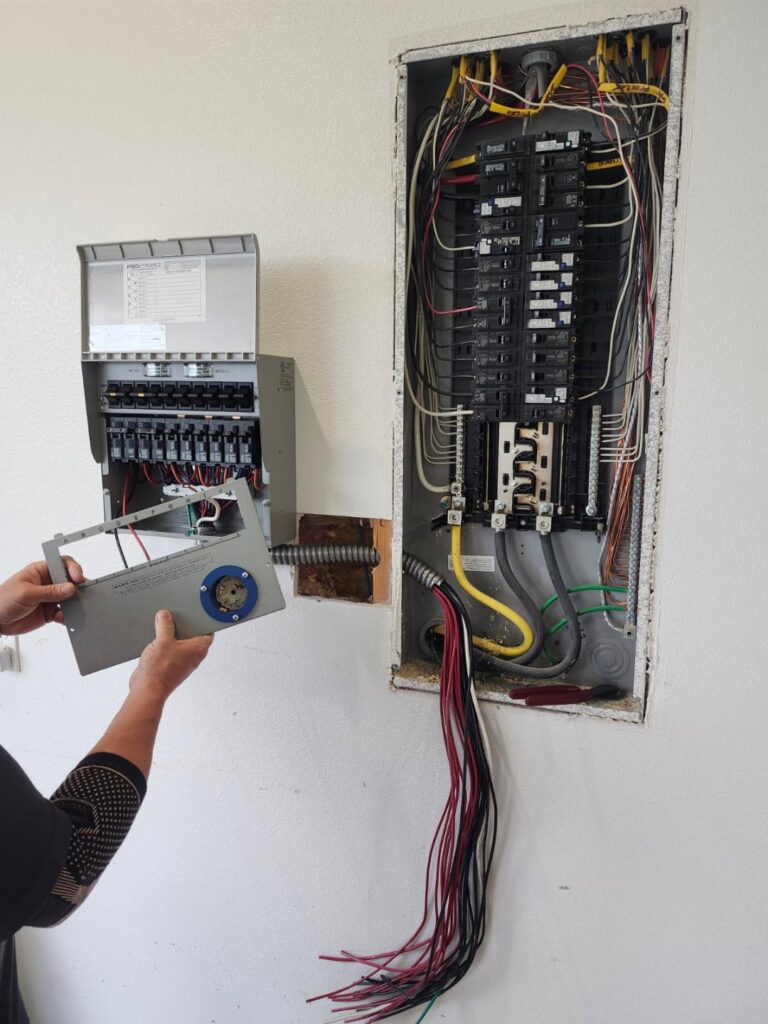
If you have a Challenger panel, the right first step is an inspection by a licensed electrician who can assess the actual condition of the panel and the breakers. In some cases the issue is contained to the breakers. In others the panel itself needs to be replaced. The correct answer depends on what the panel looks like inside, which is exactly why it takes someone qualified opening it up to tell you.
Epic Electric offers a breaker box tune-up for Bella Vista homeowners who want to know what they are dealing with before it becomes an emergency or an insurance problem. Shannon opens the panel, checks and tightens the connections, looks for the heat damage that does not show from the outside, and tells you plainly whether you have a problem and what it will take to fix it. As with every Epic Electric job, you get the price before any work begins.
Shannon’s frustration is that almost nobody checks until something fails. “Nobody’s proactive,” he says. “Catch the hazard, or catch the problem before it’s a hazard. If something’s overheating, let’s get it fixed before the thing melts.”
If your Bella Vista home was built in the 1980s or 1990s and the panel has never been replaced, it is worth two minutes to walk out and read the label. If it says Challenger, call Epic Electric at (479) 440-3742. Licensed and insured, serving Bella Vista and all of Northwest Arkansas.