New Home Old Problems What NWA Electricians Are Finding in Brand New Construction
Electrical Problems in New Construction Homes, Benton County is in the middle of one of the most sustained residential construction booms in its history. New subdivisions are going up across Bentonville, Centerton, Rogers, and Lowell on parcels that were farmland a few years ago. The pace is unlike anything the region has seen before.
What is also real is what that pace does to the quality of the work going on inside the walls.
Shannon Hadley, the owner of Epic Electric, rarely ends up on new construction jobs, and the reason is straightforward. Builders working at the pace and margin of the current NWA market are not typically looking for an electrician with more than 25 years of experience. “Builders pay a dollar fifty a square foot for electrical work,” Shannon says. That price point attracts labor, but not the kind of experience Shannon has built over his career. What he gets instead are the calls that come after the builder is gone, the homeowner who moved into a brand new house somewhere in Benton County, and is already having electrical problems.
Those calls have become a regular part of the job across Benton County. Shannon expects them to continue for the next several years as the current wave of construction ages into its first round of symptoms.
Why does new construction electrical work vary so much
Building a house in a fast-growing market means coordinating dozens of subcontractors under tight timelines and tighter budgets. Electrical rough-in, the wiring that goes in before the drywall, is typically bid out to whoever can do it fastest at the lowest cost. Rushed installations and subpar materials are among the most common sources of new home electrical defects, and the National Association of Home Builders has found that electrical systems are among the most commonly cited defects in new home warranty claims.
The work passes inspection. That is important to understand. Most of what Epic Electric finds in newer NWA homes is not a code violation. It is work that meets the minimum standard required to pass and no more. Minimum code compliance and quality installation are not the same thing, and the gap between them shows up over time.
What Shannon finds when he gets called to a newer home
The call usually starts with something that sounds minor. A light fixture that needs to be swapped, an outlet that stopped working, and a breaker that has tripped a couple of times. Shannon shows up, starts looking, and the homeowner mentions that, actually, there are a few other things that have been a little off since they moved in.
“I get called to hang a light, and the homeowner tells me their whole electrical system has been giving them problems,” Shannon says. “Flickering lights, breakers tripping. In a brand new house.”
The specific issues vary, but a few show up consistently across the newer construction in Bentonville, Centerton, Rogers, and Lowell.
Backstabbed outlets and switches. Backstabbing is a wiring shortcut where, instead of securing wires around a screw terminal, an electrician pushes them into small holes in the back of the device. It is faster. The connection is weaker. Over time, backstabbed connections loosen and cause intermittent power loss, flickering, and in worst cases, heat buildup behind the wall. It is one of the most common sources of unexplained power problems in homes just a few years old.
Circuits are loaded to the minimum. Builders frequently wire new homes with the minimum number of circuits allowed by code to reduce material and labor costs. That means a home that technically complies with the electrical code but has very little headroom for how the homeowner actually lives in it. Adding an EV charger, a home office, a garage workshop, or even just a chest freezer can push a builder-grade panel closer to its limit than most homeowners realize.
Insufficient GFCI protection. Failing to install enough GFCI protection in wet areas is one of the most common mistakes in new construction wiring. Kitchens, bathrooms, garages, and exterior outlets all require GFCI protection under the current code. It is not unusual for Epic Electric to find bathrooms or garage outlets in newer homes that were wired without it.
Wiring is not properly protected. Wires in new construction are frequently run without adequate clearance from screws and nails in framing. A drywall screw driven into a wire that was run too close to the face of a stud creates an invisible problem inside the wall that may not cause symptoms immediately, but will eventually.
The panel question in newer NWA homes
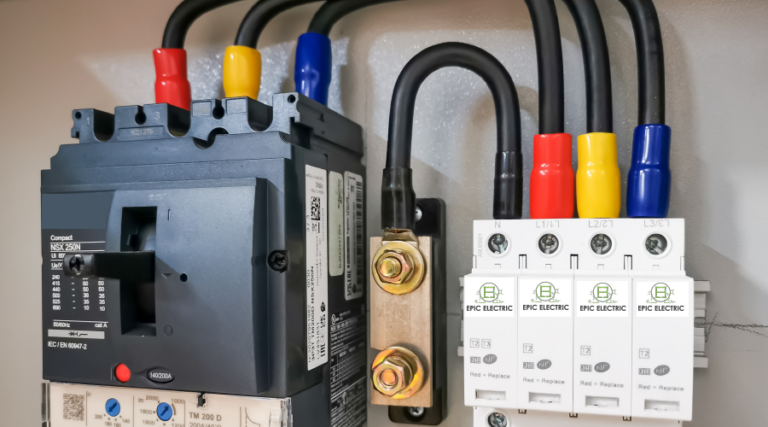
Most new construction in Bentonville, Centerton, Rogers, and Lowell goes in with a 200-amp panel, which is the current residential standard and is adequate for a typical load. The issue is not usually the panel size. It is what is already committed to it.
Builders wire the home for the home as designed, not for the home as the owner will actually use it. By the time a homeowner in a new Centerton subdivision wants to add a Level 2 EV charger, a generator transfer switch, and a dedicated circuit for a home office, the panel that looked like plenty of capacity on move-in day starts to look a lot tighter. Epic Electric regularly does this assessment for homeowners across Benton County who want to add something and are not sure whether the panel can support it.
What new construction homeowners should do
A new home comes with a builder’s warranty, and electrical defects within the warranty period should be documented and reported to the builder. Beyond that, there are a few things worth doing regardless of the builder’s warranty status.
- Test every GFCI outlet in the home. Press the test button. If it does not trip, or if the reset does not restore power, the outlet is not functioning and needs to be replaced.
- Check every outlet for consistent power. An outlet that does not work in a new home is either wired incorrectly, wired with a loose backstabbed connection, or on a GFCI circuit upstream that has tripped. Each one is worth investigating.
- Pay attention to flickering. Lights that flicker in a new home are not normal. They usually point to a loose connection somewhere in the circuit.
- Get the panel assessed before adding major loads. Before installing an EV charger, a generator circuit, or any other significant addition, have a licensed electrician look at what is already on the panel and what headroom actually exists.
Epic Electric does not build houses. What Shannon does is fix what the people who build houses sometimes get wrong, and in a market growing as fast as Northwest Arkansas right now, that work is consistent.
If you are in a newer home anywhere across Benton County and something in the electrical system has not felt right since you moved in, that is worth a call. Epic Electric serves the entire Northwest Arkansas area with same-day service and upfront pricing. Licensed and insured. Call (479) 440-3742.